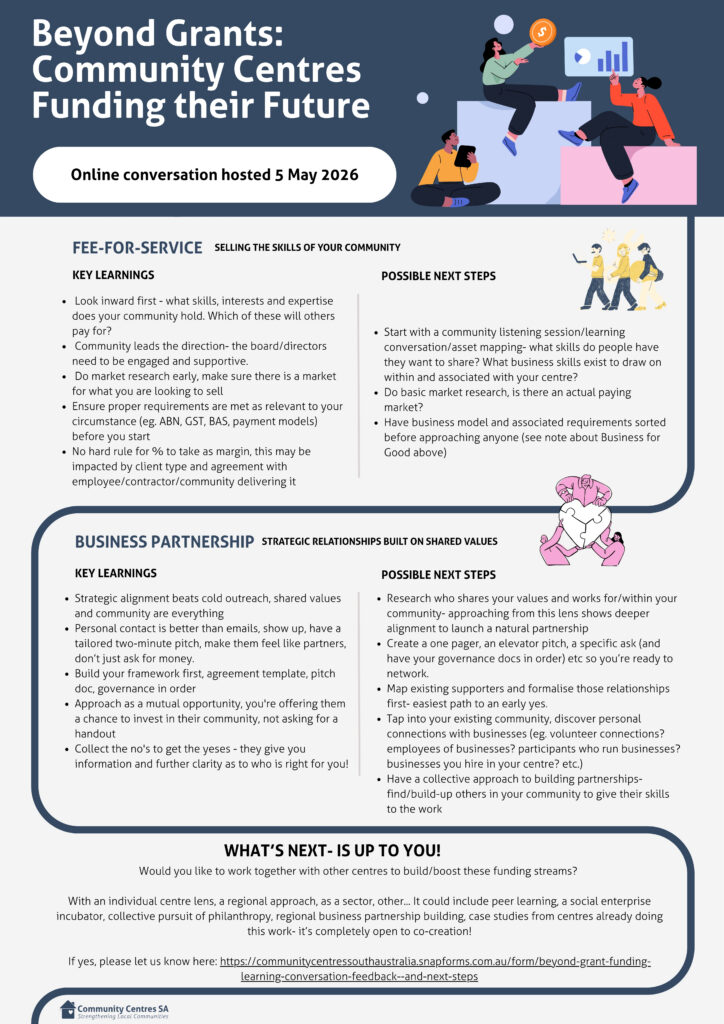

A Learning Conversation
Beyond Grants: Community Centres Funding Their Future
Without a doubt the main topic of priority and challenge facing our sector is that of funding. Funding for the work’s sustainability, structure, resourcing, evaluation, longevity and future – all to benefit the communities our centres are embedded in.
This learning conversation, held in May 2026, invites the sector into a broad exploration of four alternative funding streams to traditional grants: social enterprise, philanthropy, fee-for-service, and business partnerships.
It is a starting point for a bigger, participatory, conversation we are inviting our sector to dive into, building on the knowledge, creativity, and experience that already exists within each neighbourhood.
Our speakers are: Amy Orange – Co-founder and Managing Director of Collab4Good; Sophie Doyle – CEO of Foundation SA; Mike Penberthy – General Manager of Iwiri; Cathy Becker – Strategic Partnerships and Fundraising Manager ac.care. The hosts are Bec Cox, CEO of Community Centres SA, and Lauren Bonnet, Programs Manager at Community Centres SA.
Please note: this transcript was autogenerated and may contain errors or incorrect names and information
Rebecca Cox 0:13
I acknowledge the Kaurna people and I pay my respects to all elders past and present. Sovereignty was never ceded, always was, always will be Aboriginal land.
Welcome everybody and thank you so much for joining us today. My name’s Bec and co-hosting with me today is my colleague Lauren and we’re really glad that you’re all here. Just a few housekeeping notes before we jump in. We are recording today’s session and we will be sharing the recording after the event so feel free to share it with colleagues.
who couldn’t make it today. We are going to put everybody on mute. Our magical assistant, Rikki, will help us with that. Please do keep your video on though if you’re able to. We know what that’s like to be able to speak to actual faces makes such a difference. The format of today will be a series of questions.
directed to our guests. And then if time allows, we’ll open up for questions from the audience. Keep an eye across the top on that Q&A function that you can see across the top there. And if you see a question that you’d also like answered, give it an upvote, the little arrow on the question.
We only have one hour today and it is an ambitious agenda. We’ll be watching the clock really closely. So if we don’t get to every question, we will take them on notice and we’ll follow up in another way.
And handle to Lauren.
Lauren Bonnet 1:30
Thanks, Beck.
Hello, everyone. So the context for today’s conversation really came out of conversation after conversation with all of you across our sector. When we ask what’s top of mind when we go and visit and when we do surveys and all of that, for centres, it’s always funding that. It’s the number one thing.
So without a doubt, and I think the fact that 77 people registered for today shows that this is a topic we’re all hungry for. So through conversation today, we want to open up the possibilities of what our sector could explore and look at more broadly, broadly, not so much deeply because of time.
but we’re going to look across 4 main areas. So social enterprise, philanthropy, fee for service and business partnerships, which of course also overlap with each other at times too. We want to be clear up front that we know none of these are a quick fix or a one size fits all.
But there is possibility here and the right approach and the right context and the right centre can be really meaningful fit. So we also want to acknowledge that this is not new ground for our sector. There are people already with a wealth of knowledge and experience sitting across community centres in South Australia doing this work, trialling
things and learning and delivering in ways that have made real impact in their communities. So we want to honour the innovation and expertise that already exists across our sector. And hopefully this conversation adds to it. Our intention for this conversation today is really it’s a first step.
So it’s to start a broader conversation and maybe a more participatory one in the future. So we’ll say more about what that might look like at the end of the session. But for now, let’s introduce our amazing speakers who have given their time up for us today. Beck’s going to do the intros for us.
Rebecca Cox 3:34
Thanks, Lauren. And I guess if I can ask you to give a little wave as I introduce you, that would be great so we can see who you all are. So firstly, Amy Orange is the co-founder and managing director of CoLab for Good, a South Australian social enterprise that brings impact-driven people and organisations together to collaborate for good.
You would be hard pressed in South Australia to find someone more knowledgeable or passionate about social enterprise than Amy. Welcome Amy.
Sophie Doyle is the CEO of Foundation SA, our statewide community foundation, connecting South Australians who want to give effectively with amazing organisations and people doing the work on the ground. Sophie is also a board member of CCSA and someone uniquely placed to help us explore philanthropy as a sector today.
So, welcome, Sophia.
Mike Penpathy is the General Manager of Iweri, an Ananu-led organisation based in Adelaide that keeps culture, language and community strong. Iweri has a unique operating approach, including an interpreting and translating service that Mike will share as a valuable example of what community-led fee-for-service models can look like in practice.
So welcome, Mike.
And Cathy Becker works with AC Care in Mount Gambier as their strategic partnerships and fundraising manager. She comes with a long history in small business ownership and was most recently the coordinator at Mount Gambier Community Centre, which makes her the perfect person to help us explore business partnerships from a centre perspective today.
So welcome, Cathy.
Cathy Beckman 5:05
Thank you.
Rebecca Cox 5:06
And thank you all so much for being here. We’re going to jump straight into it.
Lauren Bonnet 5:11
So our question, our first question is for everyone, and really it’s designed to give us all a bit of a grounding on, because these terms can mean different things to different people. So really, how would you describe your funding model? Like what are the core principles? Who are the key players?
Really, how does it work in practice? And if it’s relevant to your funding stream, are there any legal or governance or structural requirements that centres need to be aware of? Amy, do you want to kick us off?
Amy Orange 5:42
Yeah, happy to. And thanks so much again for having us. And yes, self-proclaimed social enterprise nerd here. And just want to acknowledge that I’m joining from Paramount Country and in the beautiful Adelaide Hills. So I’m talking about social enterprise. So social enterprises are essentially just businesses that exist to make the world a better place. From A definitional perspective or an understanding kind of the key fundamentals of social enterprise, they do 3 main things. So the first is that they are led by an economic, social, cultural or environmental mission that’s consistent with a public or community benefit. So, you know, really that public or community benefit versus private gain. The second kind of key fundamental element of a social enterprise is that they trade a product or service to fulfil their mission and that they do derive A substantial portion of their revenue and their income from this trade. So rather than
relying too heavily on fundraising or donations and grants. And the third element is that they reinvest the majority of their profit or surplus back into their social purpose. And that can look quite different, again, depending on the type of impact model that you have. So social enterprise is essentially, it’s the heart of a non-profit combined with the head of a business, really.
And just some examples of the kind of models that social enterprises have. So they might be set up to create employment for marginalized people. They might be able to fill a community need for access to affordable or accessible services. They might drive a circular economy, or they might distribute, you know, at least 50% of their profits back to mission-driven partners to deliver that.
They tend to be led by, you know, social entrepreneurs or sometimes intrapreneurs, so those within organisations who kind of see an opportunity and, you know, want to, you know, working with a bigger organisation and have the resources to try and set up a social enterprise that’s either attached to the organisation or it could also be a separate entity. And social enterprise is a business model, so it’s not a legal structure. So there is no, there’s no legal
structure that enables you to be a social enterprise. You have to choose from the existing range of non-profit or non-profit or for-profit legal structures. But we do have a certification model in the whole of Australia that’s run by social traders where you can get certified by an independent third party to kind of assess, you know, they’ll look at your governance.
structure and your financial statements, any of your other legal documents, your business plans and your impact metrics, and then make an assessment that you are meeting those sort of three things that I mentioned earlier. But they operate in every industry, in every sector. You’ll find them everywhere. They’ve been around for a long time, but the name social enterprise is perhaps a little bit more new to it. So
That’s a very quick overview of social enterprise.
Lauren Bonnet 8:23
Yes, thank you for the crash course. That was phenomenal. Sophie, do you want to take it away with philanthropy?
Sophie Doyle 8:31
Yes, absolutely. Hi everyone. Thank you to CCSA for having us here today. So philanthropy, it’s really topical. It’s essay giving week, everyone, the inaugural giving week for South Australia this week. So it’s really great timing that you guys are running this session. So philanthropy is, I mean, at its core, it’s about the love of humanity. It comes from the Greek word, but it’s really about giving without
Cathy Beckman 8:33
Okay.
Sophie Doyle 8:55
expecting anything in return. And I guess that’s where it differs from sponsorship. So you’ve got corporates who will sponsor things and expect logo recognition and that kind of thing. Whereas philanthropists are giving of their funds or their time without that expectation of anything in return. And so I think when we do talk about giving and this week, there are a number of events actually that you could try and get involved in if you had time.
There’s A SA Giving website that you can have a look at. But essentially, we’re really trying to emphasise the fact that philanthropy is not just about money. And it is there are so many other things that people can give. And so when you’re speaking in your community, it’s worthwhile thinking about that. And I know a lot of you have a number of volunteers and people that support your centres.
So how could that be expanded? There’s not an, you know, funds and things are limited, but people’s time and capacity and desire to give is often there and they’re just waiting to be asked. So we talk about time, talent and treasure and your ties. So what connections do people in your community have that might help you to bring others in? You might think, well, I don’t know any philanthropists, but who in your community might?
And when we talk about philanthropy, it can be at all levels. So there’s the ties, people’s time, obviously, with volunteering, their talent, so pro bono skills, so what skills are out there in community that you could tap into. And then of course, treasure being the funding. And when we talk about funding, it’s sort of…
Philanthropy is really broken down into private philanthropy, so families that have structures and foundations to give, corporate giving, so corporate or businesses, which I know a number of you already have relationships with local businesses in your area, and then community philanthropy, which is what we are as Foundation SA, as a community foundation. And we do have seven community foundations across the state that you could tap into as well. And I can send round links.
To those, and share that information.
Lauren Bonnet 10:51
Thank you. Yes, good point. All the information that’s shared today, we will try and disperse stuff afterwards. So taking notes is great. We’ll help out as well. Cathy, do you want to share about what are the core principles of business partnership in your mind?
Cathy Beckman 11:07
Yes, certainly. Thanks Lauren and Bec for inviting me on today to represent AC Care. So as a strategic partnership and fundraising manager, I guess I look at it from a point of view, do you want to spend a bit of time
going out asking for a donation and sending out a letter and hoping, or do you want to spend a bit of time making it strategic and building a strategic partnership for a more productive outcome? So this model that I use in building the strategic partnerships
is to create the partnerships to create sustainability within your organisation. And that’s going to build a stronger foundation. It’s going to, like I said, build that sustainability. And then you can build on those relationships, not just for a once-off donation. You can keep
Once you’ve got those core foundational partnerships, you can go back to those because you’ve built up that relationship, that rapport. It is a lot about aligning yourself strategically with the correct businesses, the correct organisations and companies, thinking about who you share the same values as, the
the same mission, the same values, and approaching those businesses, those companies personally, and looking at it as an investment. We don’t want these people to feel undervalued. So it is a way of them investing in your organization.
like Sophie said, whether that be financially, whether it be in kind, or whether it be in what we call people purpose or participation with volunteering. So it is important to get that framework together to take the time to make sure that you know your purpose of why you’re…
strategically aligning yourself with that particular business that you’re going to approach, what their support is going to enable you to do and how they can feel valued within that relationship as well is a big point. From a legal point of view, obviously being non-for-profit because we want to be able to
Then have the required receipts and licensing as a charity to be able to make it tax deductible, making sure that you’re doing the correct record keeping, etc. And making sure that you’ve just got all your governance into place with your leadership team is really, really important. So spending
of time in getting that right to start off with before you actually go out there and approach these businesses and organisations that you’re going to align yourself with.
Lauren Bonnet 14:06
Thank you, Cathy. Yeah, so many bits and pieces to think of. And I can think DGR1 is probably something that is relevant to philanthropy as well, that’s probably worth mentioning. But yes, it’s all complicated, isn’t it? Mike, you’re here representing
Cathy Beckman 14:14
Yes.
Lauren Bonnet 14:26
a very specific organization-led fee-for-service. So can you share with us what are sort of the core principles of how you guys operate your service?
Mike 14:39
Thanks, Lauren. And look, that’s right. I think we are fairly unique in the way that we, like, it’s, I’m going to give quite a specific example rather than a more general one. So, Ewerri is an Aboriginal organisation that was formed by the Anangal Bidjarri Yangatja Jarrah community living here in Adelaide. So, people from the APY lands in the northwest of South Australia
who are now living in Adelaide. Many of our members have some significant health issues. They’re down here because they need dialysis or other forms of ongoing health care. And their family members are here with them. And so we were formed by the Armingong community who…
really wanted an organisation that would look after their particular needs and also to form a, to establish a place where they could gather together, speak Bidojara with each other and continue to practice their culture. So we are essentially a charity and, but
We do get a significant portion of our income through fee for service work that we do. So it probably touches on some of the social enterprise aspects that Amy was talking about before. Although I think this year about half of our income will come through competitive grants that we’ve applied for, the fee for service work is a significant component.
The sort of things we do, we have an art centre, and you can kind of see some of the paintings in the back here. We run an art centre where people can come and produce paintings and ceramics. We also support people with a range of sort of social issues that they encounter.
But the way that we have earned some fee for service income is really by providing opportunities for Annabel people to sell the skills that they have. And so we, within the art centre, we provide canvases and paints and all Australian materials. And then as an organisation, we…
or earn a small commission on the sale of the artworks that are produced. The other fee for service work that we’ve been able to do is to take contracts to do translation work for government departments or sometimes for private enterprises. A number of government departments have needed.
materials translated into Bidindjara and that’s a skill that our members have and so we’ve been able to charge for that. We also charge out for cultural education and for language training as well. So in order to do that, as I said, we’re a charity, we are registered with the ACNC.
We’re also registered with the Office of Indigenous Corporations, so our ACNC registration is attached to our ORIC registration and we have DGR status as well. But to run the fee-for-service part of our work, obviously we have an ABN, we’re registered for GST.
We submit a BAS every quarter and pay GST every quarter, so just like any other business. But all of the profits that we make obviously go back to the organisation and are used for the charitable purposes of the organisation. I could go on and talk in more detail, but that’s…
That’s probably the general summary and happy to take questions.
Rebecca Cox 18:07
Thanks so much, Mike. And just a reminder, if you guys do have questions for today, please pop them in the Q&A function across the top of your Team channel. We’re going to keep moving because we’ve got some more questions for our guests today that might help answer some of the questions that might be ruminating in the room. This next question is particularly directed to Sophia and to Cathy.
And it’s about what makes the models work in practice. So what are the real building blocks that tend to make this work? Is it about knowledge, relationships, internal capacity, time investment, connection to community? So we’re going to start with Sophia and then we’ll pass to Cathy.
Sophie Doyle 18:45
Yes, it is all of those things, Bec. With philanthropy, it is a lot about relationships, which is really time consuming because it’s all trust-based. But that’s where the community foundation can come in because community foundations play this unique role between the community
and hearing the voice and the need of community and articulating that through to funders and those that are doing the giving. And so there is kind of a unique role there and it’s probably more accessible in terms of community centres accessing funding to be talking to community foundations.
in your local areas than some of the, say, private foundations. But that’s not to say they’re not an option. And I think there’s some internal capacity building and there are tools out there. So you may well know of strategic grants, which is a platform in terms of knowing what grant rounds are available. Often grant rounds are open and so anyone can apply.
Sometimes they’re closed and so you sort of will start the process with a funder of applying for an open grant round, receiving some funding, building on a relationship and then you might be invited in to ask for additional funding for different further projects or expanding on something that you’ve already worked on with that funder. So there needs to be a way in and I think sometimes it’s that first grant. I know that the success rate with grants isn’t that high and it’s really
time consuming work to be doing that. In terms of building the connections with those organisations so that you’re not going in cold when you’re writing those grants, there is something called the SA Philanthropy Network here who run events throughout the year that are free, that are all about connecting and educating funders and connecting community organisations with funders.
There’s Philanthropy Australia, which is the national peak body. So getting even just if you can’t afford necessarily joining them as a member, they do have a newsletter that comes out fortnightly that it’s quite interesting, at least grants that are available. And just starting to think about the language and what funders are looking at in terms of impact measurement and how they express the types of programs that they’re funding. It would be quite interesting to see that.
FRRR, the Foundation for Regional and Rural Renewal, is another national organisation that does that work, especially in our regional areas. And Foundation SA, we have our own, we have a neighbourhood grants program that are for small community-led projects that are led by community is the criteria for that. And so we run that once a year as well.
So there are things that can be, you know, you can do in terms of building those connections, but it is a long game. It is a relationship-based game in terms of building trust. Yeah, so don’t underestimate that, and I appreciate that’s difficult when you’ve got other things to do.
Rebecca Cox 21:29
Yeah, there’s some really great leads already coming out of this conversation that I’m making notes about, so I’m sure that resonates for the people at the table as well. That’s really interesting, Sophia. Cathy, over to you. What are the building blocks that make business partnerships really work?
Cathy Beckman 21:44
Yeah, obviously like Sophia, relationship building and taking the time to do that is a huge, huge thing to focus on and building that connection and that rapport and understanding that that does take time and you’re not necessarily going to get
that strategic partnership commitment within that first meeting. So, and it is known in marketing, you know, you need at least five touch points for someone to recognise your logo, for someone to remember who you are, for someone to understand what your business does. So every point of contact that you make
is an important one. And whether that be your first initial meeting and then follow up with an email. That second point of contact is the email. They recognise your name and your organisation again. So just making sure that you take the time and the commitment to have that.
regular contact with whoever you are approaching. But before you do that, you need to make the time to have the correct framework to be able to go out to look for these strategic partnerships. And like I said, aligning yourself that has the same core principle as you, wants the same outcomes, has the same values.
Rebecca Cox 22:57
Okay.
Cathy Beckman 23:01
is a really good start. There’s no good in going to someone in a completely different area of focus because you’re going to be disappointed with your outcome. You need to have a clear defined purpose of what you’re proposing to them.
have something on paper to go with, have a flyer, have something so you can step them through it, you can look professional. We have formatted a formal agreement, partnership agreement. Now in this agreement, it’s not only about what we want as an organisation, but it’s
gives us clear outcomes of what the partner expects and wants and makes us review that to make sure that we’re delivering to their expectations as well, because we want it to be mutually beneficial. And your partners are going to work more with you if they feel they are valued, if they feel…
that they have, they’re being heard. In that agreement, it’s important to put in there that you have the correct paperwork that is needed, whether there’s working with children’s checks, national police checks, confidentiality forms, if there’s any of those that your organisation requires.
It’s a formal way of letting them know that these are required and making sure that they’re ticked off. And also, you know, having in there that you are going to review this partnership once every 12 months to make sure that everyone is happy where it’s at, where it’s heading, where potentially.
it can go. And I think you get a lot of respect out of taking the time to do it that way as well. And yeah, you’ll get a much better outcome than hoping for a donation. Look for a strategic partnership.
Rebecca Cox 24:59
Yeah, that’s really fascinating, isn’t it? And really understanding your intention before you start that process. We’ve got a couple of minutes up our sleeve, Amy. I hope I’m not putting you on the spot. Could I ask you to answer the same question from a social enterprise lens, which is about the building blocks that make this model really work?
Amy Orange 25:16
Yeah, for sure. In terms of where you might start with a social enterprise model, if that’s something that you’re looking at, is you really want to start with why. You want to start with, you know, why do you want to start a social enterprise and particularly kind of what social, environmental or cultural problem it is that you might want to tackle. You know, from there, you probably want to build out a theory of change where you might just get a bit of a sense of, you know, what’s the problem that you’re trying to solve.
what’s the impact that you’re trying to have and how your social enterprise might design some activities to generate the outcomes that can contribute to that ultimate impact. Then I guess the other kind of key step is that you want to then look at how you can develop a business model that aligns really nicely with that impact model. So the business model being that commercial driver that generates the revenue,
that you need to be able to resource and drive the impact in your impact model. And through that, you really want to be testing your assumptions at both your impact model and your business model. You want to really make sure that you are including the voices of those who are directly affected by the problem when you’re designing your solutions and really incorporating
Lauren Bonnet 26:17
Okay.
Amy Orange 26:22
co-design principles and engaging people with lived experience, you know, as part of that design process. Going through an incubator or an accelerator program, attending workshops, kind of getting involved. We have the South Australian Social Enterprise Council, otherwise known as CCSA, love a good acronym. So, you know, you can join as either an ordinary member, as a social enterprise or an associate member if you’re just really interested and you want to support and, you know, come along.
and meet others doing this work and get access to, yeah, just opportunities, tips and resources. And yeah, we’ve also got a business for good program that we offer. And I think Lauren’s going to send out some information about that program afterwards. So I won’t go into it too much, but there is some, yeah, some opportunities for some capacity building as well, if social enterprise is something that you’re interested in.
Lauren Bonnet 27:00
Okay.
Rebecca Cox 27:07
Fantastic, exactly.
Lauren Bonnet 27:08
Thank you, Amy. Yeah, and yes, we will send out all the links to these things. Our next question is something that comes up a bit in our sector, and that is really around how do we do this when we’re already so strapped for time and resource. So
Amy Orange 27:09
Yeah.
Lauren Bonnet 27:27
With that in mind, does this funding model or your funding models lend themselves to a collective or a community-led approach? And if so, how? So could it be shared across networks of centres or driven by community members themselves? Yeah, I’m going to throw it back to you, Amy, because I feel like
This is in the same thread of where you were already at.
Amy Orange 27:53
Yeah, thank you. And absolutely, I think social enterprise is such a beautiful community-based model and community-led model. I mean, as I mentioned earlier, when I talked about the foundations of what a social enterprise is, it’s always about more than the individual or private gain. It’s always about that public and community benefit. More often than not, social enterprises are driven from the ground up, you know, by the people who either
have lived experience of the problem that they’re trying to solve or, you know, have been quite close to it or who just feel really passionately about it. And that power is a pretty incredible driver and often sets up quite an incredible resilience as well. We actually find that social enterprises tend to last longer than traditional businesses. I think sometimes just due to that real passion and resilience that comes into it.
Lauren Bonnet 28:26
Yeah.
Amy Orange 28:35
But the key is really finding a social enterprise model that more than one person is passionate about. And I think that’s sort of where the challenge, you know, might sit with the community centres is that it is really hard just for one person and particularly a community centre coordinator to have the time and energy to design, develop and establish and run a social enterprise.
So we definitely look at, you know, engaging volunteers. We’ve worked with a local community centre that got a group of volunteers together to come through an accelerator program and try and sort of, you know, take the lead. Joining forces across a network of community centres is another fantastic idea, you know, particularly if there’s a shared resource that kind of connects a network. So for an example, there might be a really
fruitful olive grove or something, you know, in an area and that is adjacent to a couple of community centres. They use that, they generally create turning those olives into olive oil and then they sell that olive oil and the profits going to go back to, you know, split between the community centres. But they get to then pull resources, you know, get more people involved. And yeah, it’s a great model for doing that.
But it’s just a great model to get community involved as well in the design process and really getting them engaged in, you know, right from the start, like kind of being involved in what could this look like? What kind of, you know, what kind of products and services could we do? What could our impact model be? You know, what should we do with any profits or surplus? Like really getting everyone involved in the decision making around that is a really nice way to get that buy-in. And then everyone just feels like,
bit of a sense of ownership and sort of community, collective, you know, togetherness around it. And that’s a really powerful thing when it comes to running a social enterprise.
Lauren Bonnet 30:16
Yeah, really valuable. Like it’s a different reframing of how we might start things in community centres sometimes. Mike, so we know yours is led by the fact of the skills. How did you put it? You put it the selling the skills of the people in your community. How did that actually practice?
practically go about happening. I think it was before your time, but I’m sure you’re in the know of how it was set up. The translating service, the art service, how did it start from being something people just naturally did to being something you can actually sell.
Mike 30:53
Yeah, well, it was very much community driven. So, as I said, it was an organisation. All of our directors are Anangal, and one of the, you know, the very early sort of strategic directions that were set by the directors was to support employment opportunities for Anangal people in Adelaide. And so, we really looked…
The organisation looked around for how can we help Annabel people earn some income. And so we looked at the skills that our members had, which was the ability to speak Bidin Jarrah. Some of them were successful artists and had been painting in art centres up in the APY lands and were keen to continue painting.
So the objective has always been to generate income for our members. And so I guess that happens at 2 levels. So for the individuals who do the translating work or who we facilitate to get workers interpreters, they’re obviously paid for that. And IWRI’s role as an organisation is to facilitate those jobs. So we will
take the inquiries for people, for organisations who want some translating done or some interpreting. We’ll make the booking, we’ll arrange for people to be where they need to be, and then we quote for it, for the, you know, for the cost of the job, and then from the, and then we also then pay.
you know, a reasonable wage to the people who, to our members who are doing the translating or the interpreting. And art sales probably work in a similar way. We provide all the resources. We provide the studio, the paints, the ceramics, fire the pots, all those sorts of things, and then arrange for the sale of art.
of artworks through galleries around Australia and our members who do the artwork are then, you know, paid for the paint or the artworks that they sell. And we take a commission for the, you know, for supplying all the materials and facilitating the sale. So it’s a way of…
Our members earning income, personal income, and also we’re as an organisation generating some income just to keep the organisation going.
Lauren Bonnet 33:05
Thanks.
Rebecca Cox 33:09
Right, we’re going to move on to our next question, which is looking for a response from each of our guests today. So if you were a centre coordinator or a board member and you wanted to start exploring one of these models tomorrow, where would you actually begin? What’s the first step that you would take?
So, for example, could it be a conversation with your board or your community? Would it be internal groundwork and, you know, setting out what the scope of an agreement might look like? Is there a resource or a network that you’d recommend that people reach out to? So we’re going to start with you, Cathy, and then move around the board.
Cathy Beckman 33:49
Yeah, sure. Yeah, obviously the first step would be going to your board, your leadership team, and just making sure that you’ve got the correct governance all in place before going out and just asking, you know, for strategic partnerships.
Like I said before, compiling the correct documents that you need to make sure that you’ve got that supported framework is A, going to make you look more professional, but also make you feel more confident as well. And you can work with your marketing team on that.
to make the flyers, you know, make sure, you know, whether you want to present it all in a folder with the governance material in there that you need, whether it’s, like I said before, working with children’s check, National Police check information.
And then, you know, look at your database, look at who you’re already working with, who might already be helping you out in your organization. You know, you don’t necessarily have to start with going out and finding someone new. You know, it’s going to give you a really big confidence.
boost if you start off with a yes. And I’m always a big believer in you have to collect the no’s to get the yeses. So don’t be discouraged if someone doesn’t formalise A partnership with you straight away. That’s just another one to rack up to know that you’re getting closer to the yes.
If you have all that framework done and you feel confident going out, you are going to sell that partnership to whoever you’re approaching. So like I said, don’t underestimate people who are already involved in your organisation and offer them to formalise their
their agreement that they’ve got with you, whether they come in and they help in kind, whether they come in and they offer trade assistance or financial assistance. It actually gives you, like I said before, another level of respect and makes them feel valued to think that
all of a sudden, you know, you want to make a formal agreement with this. And the most important thing would be is when you are strategically aligning this and looking for those key stakeholders is to, you know, look at, you know, we’re doing it for a community centre. Who is community, who has that?
shared community spirit. Who would want to partner with you to make that difference? Really give that some thought. And this all takes time. You know, like I said, building that framework, working out who you are going to approach, who has those common goals. But if you take a little bit of time to get that right,
you’re going to get a much more productive outcome just by doing that and strategically aligning it. It’s really, really important.
Rebecca Cox 36:59
Thanks, Cathy.
Lauren Bonnet 36:59
Cathy, can I jump in because I have some background information that I’m wondering if you would share your perspective from your experience at Mount Gambier Community Centre and your experience of putting all this into action on the ground.
Cathy Beckman 37:18
Yeah, sure. So before Christmas, we were looking for a way to come up with some more funds to help some families. And I came up with a concept and initiative of Buy A Bauble having a Christmas tree and who could we
get to buy a bauble. And we started it off, you know, people could donate whatever they wanted with that bauble, or we reached for the stars and, you know, we went from a $20 bauble up to a $2,000 bauble. One, you know, once again, I took the time to strategically align.
these partnerships and I didn’t just send out an email. Emails get lost. So I picked about a dozen businesses that I wanted to approach and I actually went out on the ground, personally delivered a letter, gave them my two-minute elevator pitch.
on what it was all about, which is another point to really perfect a quick elevator pitch can be really effective. And yeah, we got those $2,000 baubles. And one particular business actually thanked me for approaching them.
They said that they had never been approached before, but they thought it made sense because they strategically aligned with us and shared a lot of the same clients. So we’re more than happy to help. So there’s people out there, there’s businesses out there who are wanting to help, but they just need to be asked. And yeah, strategically align it and you’ll get the results you’re looking for.
Lauren Bonnet 39:03
Thanks, Cathy.
Rebecca Cox 39:03
Such a great example, Cathy. Thank you so much for sharing a practical example. That’s a great one. I’m just a gentle reminder to please put your questions for our guests in the Q&A so we can get to those at the end of this question. I’m going to move to Sophia to answer the same question. So if you were starting tomorrow, where would you start?
with philanthropy.
Sophie Doyle 39:23
Yes, so I think once you’ve done what Cathy said and you’ve got all your paperwork and all your structures in place and you’ve checked some of the legalities, I think it would be great to really, and it wouldn’t take too much consultation, I’m sure you know what the greatest need is and what the things are that you would love to be doing for your community. So what are those things?
And then what other community centres are really trying to do the same work? Because I’m sure there’s some commonality and maybe land a group of you that could work together on a couple or even just one area, a program or a service or a resource, something that you
think your community would really benefit from, that you could then look to who are the funders out there that have this kind of thing, whether it’s social work or emergency assistance services, whatever it might be, arts and culture, connecting communities, multicultural communities, who are the foundations out there? And you could look nationally if you went as a collective,
that work in this space. So start with your needs. Don’t ever start with philanthropy with trying to meet the cause areas that a foundation is listing on their website. There’s a lot of work at the moment and a lot of attention on place-based philanthropy. So federal government has a new initiative called Place. Community foundations now have a new structure called a community charity.
which is expanding their reach. We’ve grown to 75 community foundations now across the country. There’s a lot of focus nationally on community place-based work, which is exactly what you’re doing. But your voice will be heard and it will be louder if you can do it together in a collaboration.
but leading it from what you’re hearing in your community, not coming up with programs because Paul Ramsay Foundation or Minderu, whoever the big foundations are, have that as one of their areas on their website. So really listening to your community first, coming together, who’s interested in developing a bit of a strategic plan, a case for support, and then a pitch. And then who is it out there in the philanthropic community that might be interested in what we’re trying to do?
here in our community and I’d be happy to talk to people as well about who might be out there that might match up with what you’re trying to do in your community.
Rebecca Cox 41:46
Yeah, that’s fantastic and such good advice, not trying to shoehorn it into someone else’s agenda. That’s really interesting. Mike, I’m going to throw to you. In terms of faith service, where would you suggest that people interested in that funding model would start?
Mike 41:59
I think I have a similar message to the one that’s already been put forward, and let’s just start with the community. You know, start with what your community can offer on a fee-for-service basis, and you know, just, just yeah, listen to them about what they are interested in doing. I guess the next step is, obviously, you…
directors and your board need to be really engaged and supportive. So then first community, second directors, and then I think third, do some market research just to make sure that there is a market for the service that you’re looking to sell.
Rebecca Cox 42:36
Beautiful. It’s a really interesting approach from Fay for Services, isn’t it? Because it’s such a unique offering from site to site and community to community. And yours is so explicitly unique. It’s a really interesting model.
Mike 42:43
Yep.
Yeah.
Rebecca Cox 42:52
Cathy, where would you suggest? Oh, sorry, Amy, where would you suggest that people might start if they were interested in looking at social enterprise?
Amy Orange 42:56
Yeah.
Yeah, I think similar to what others have said, I think, you know, if you’re a community centre coordinator, you do probably want to have a chat with your leadership or your board to make sure that there is some, I guess, some appetite from that level in terms of not necessarily running a social enterprise or creating a social enterprise, but just an openness to you or a volunteer, possibly just, you know, doing some research and just investigating just to see if there’s something that might be of interest. It could just be running a
a workshop or engaging a volunteer to do a little bit more research. So I think, you know, yeah, getting that buy-in from that leadership level and getting a sense of whether there is even any appetite is probably a good thing to do before you do start going out and talking to community, because if you get someone who’s really excited about the idea, but then, you know, the centre leadership and board, you know, won’t back it or won’t put any resources into it, then that could also be quite disappointing. So probably starting there.
So yeah, if it’s a community centre coordinator talking to your board, if you’re a volunteer on this call, have a chat with your community centre coordinator and they’ll, you know, they’ll have those conversations and kind of be able to let you know, you know, what the position of the board and leadership is there. Then I guess you want to, you know, like we’ve kind of already just said, start with the why and look at the problem. So do the research into, you know, what the social problem is that you might want to look at.
you know, have a think about what business models might align. And this could be something that, you know, a community centre coordinator could do, but you could also quite easily engage a volunteer that’s kind of interested in just undertaking some of that research to kind of understand, you know, what might be out there. And part of that might be organizing A co-design session with community members. So getting a whole group of people together from the community to just brainstorm, you know, and to get input into what a social
enterprise model could be, you know, both from the impact model perspective, but also from the commercial perspective, as Mike said, kind of like that crowdsourcing of what are the skills and products and opportunities that already exist within the community that we could potentially sort of leverage together for that community benefit. Yeah, just talking to as many people as possible. I think just don’t sit on the idea, don’t hoard it, you know,
put it out there and get feedback and just sort of see where that takes you. And hopefully if the, you know, the community centre board and leadership are open to it and there’s appetite, then you might be able to pitch something back to them and, you know, and see where that goes.
Rebecca Cox 45:18
Fantastic.
Lauren Bonnet 45:19
Looking at the chat, Tammy, I’m assuming this is Tammy from Tail and Bend, has given a huge endorsement to you guys at CoLab for Good with your Business for Good program and she’s encouraged people to get involved.
And in particular, apparently you’ve got a session in the Murraylands, no, in Murray Bridge at the Murrayland Skills Centre on the 28th of May. So if regional centres are around there, we can share those details too. I’ll grab them from you, Amy, for anyone interested.
She has asked a question, and in particular, this is for you, Sophie, around philanthropy. So how can regional and remote providers meaningfully build and sustain relationships with philanthropic funders when geographic distance limits our ability to be physically present in key networking and engagement spaces?
And what practical strategies or models have you seen that work well to bridge that gap?
Sophie Doyle 46:25
Sure. So I didn’t list them before, but the community foundations, we’re lucky enough to have 7 here now in South Australia, and that number is growing. And one of our roles as Foundation SA is to help new emerging communities develop their own community foundation. So we have, I’m not sure where everyone’s from, but we have a community foundation on the Air Peninsula called Air Peninsula Community Foundation. We’ve got Fleurio Community Foundation.
We have Barossa, so it’s called Foundation Barossa, and we have Stand Like Stone, which I’m sure Cathy is familiar with, which looks after the Limestone Coast. We also now have the Adelaide Hills Community Foundation that’s just launched, and we have the Spinifex Foundation SA, which is an Indigenous-led fund working with First Nations communities, but on a statewide basis.
like Foundation SA works statewide as well. So there are local, regional, philanthropic community foundations and they would be a good starting point. If you don’t have one and you have an interest, we could talk about setting one up. We’re talking to the Mid-North community at the moment, Kangaroo Island.
These are not difficult structures. It’s more about community willingness and interest in creating something for, you know, your own kind of wealth that you can look after in your community and then determine what the need is and to alleviate having to apply for grants. So there are regional structures. There’s also families and businesses, of course, in the regions that I’m sure many of you would be connected to or you would be able to find connections to.
And then I guess a lot of the networks I mentioned before, so Philanthropy Australia, Foundation for Regional and Rural Renewal, Australian Communities Foundation is another one. A lot of their webinars and their sessions are online. So it’s just a matter of subscribing to their newsletter, seeing when their events are coming up, and you would then have access.
to attend some of those events, just to start to see how philanthropists are talking, the kind of projects and the case studies they fund, that kind of language and that kind of thing as well.
Rebecca Cox 48:26
Yeah, that’s great and really practical advice. Thanks, Sophia. We’ve got another question in the Q&A, which is particularly about fee for service. So Mike, I’m going to throw it to you. We’ve got somebody who’s asking a general question about fee for service arrangements, which may also cross over into community centre and grant funded contexts. For example, where a community group wants to run workshops for young people, but pay members from the community group.
to facilitate sessions based on their skills. When those community members are paid for their time rather than volunteering, are there common approaches around whether an ABN is required or whether people can be engaged on a hobby or one-off basis using a statement by supplier? There is another question about fee for service and I’m going to throw it to you as part B of that question, which is about…
Is there a percentage of profit that you might look for from a fee-for-service arrangement? So perhaps if I can ask you, Mike, to cover off on your thoughts on both of those questions.
Mike 49:15
Yeah, sure. So the first question was, how do we pay community members for doing fee for service work? They’re usually taken on as employees, but casual employees. So we sign them up as casual employees and then pay them at an agreed rate. So some of our
members we paid according to the SHADS award if they’re doing work in and around the centre. For our translators and interpreters, we actually pay them under the SHADS award, but at a much higher rate because they usually work, it’s quite a specialist skill and they typically work for just, you know, for a three-hour period and they might work 3 hours one week and then…
you know, there may be no work for another couple of weeks or something like that. So yes, that’s generally the way we do it. We do have some, one or two members who we will pay, they will invoice us. So I guess they’d pay us, we employ them as contractors. So it depends. Yeah.
That was the first part of the question. That was the second one, Rebecca.
Rebecca Cox 50:18
Yeah, the second part of the question, or second separate question I should say, is from a fee-for-service perspective, is there a percentage of profit that you would aim for in that arrangement?
Mike 50:29
Again, that probably varies. So, but we do sort of try and for most jobs, we would try and make about 20% profit on the job. Yeah, but again, it varies. It depends on, you know, whether it’s for a private foundation or whether it’s for a…
It might be for an educational institution, so yes, there is some flexibility, but that’s generally what we would aim for, yeah.
Rebecca Cox 50:56
Did anyone else on the panel want to address those last two questions as well or have input to those?
Amy Orange 51:04
Happy to just chat briefly from a social enterprise perspective about the percentage of profit, you know, and you know what I was sort of introducing what a social enterprise is and what we look out for or what is looked out for certification. You know, it does tend to be sort of 50% of profits, I guess, that you’re aiming for, you know, to or to be able to retain to therefore be able to put back into your social purpose.
Rebecca Cox 51:05
Bye.
Amy Orange 51:25
But I guess just putting a caveat on that, that also social enterprises and social traders who does the certification recognises that that can be a really hard thing to do. It can actually be really quite a hard thing for social enterprises to generate profit, let alone 50%, you know, enough to put, you know, to put a substantial amount back in, particularly if you’re a profit redistribution impact model.
is your social enterprise. So just want to acknowledge, I guess, yeah, that it can take a lot of time to build that up. If certification is something you’re interested in and will be put off by that number, like often they’re quite flexible and they kind of want to know that as long as you’ve got a long-term plan to kind of increase your revenue to be able to generate as much impact as possible, yeah, that that sort of percentage of profit isn’t such a…
Such an issue.
Lauren Bonnet 52:07
Can you explain the certification quickly for us?
Amy Orange 52:12
Yeah, yep. Yep, so Social Traders is the national organisation. They’ve been running for about 17 or 18 years now. And so they run our national certification program for Australian social enterprises. And they work on the same 3 criteria that I mentioned earlier. So the fact that you exist for a public community benefit, you know, with a strong social, environmental, cultural purpose that you have
have a trade model so that you trade a product or service and that your trade revenue is, you know, generally 50% around that, you know, in terms of your revenue model. So you’re not over relying on grants and fundraising and donations. And then the third one is that you reinvest the majority, ideally sort of that 50% at least of your profits or surplus back into your social mission.
So they look at that, yeah, they look at your governance documents, so your constitution, you know, any shareholder agreements, if you’re a for-profit or a partnership organisation, your financial statements to see that there’s evidence of your impact kind of in your finances. And they’ll look at sort of your business plans and any of your impact metrics as well. So, you know, making sure basically that you are doing what you say that you’re doing and there’s no social washing going on.
which is the social enterprise equivalent of greenwashing that you’re not, yeah, saying, claiming to make impact when you’re not.
Lauren Bonnet 53:32
Thanks.
Rebecca Cox 53:34
Thank you so much for your responses and thanks also to those who put questions in the Q&A who were brave enough to ask your questions and get information that I think would have helped everybody in the room. So thank you. That actually brings us to the end of our panel conversation and what a conversation it’s been, so much information. Thank you so much to Cathy, Amy, Sophie and to Mike.
Your generosity of time and knowledge and experience today is really valued and we’re very grateful. Key messages for me as takeaways were about having really clear intention before you start this journey, about growing ideas from a community’s strengths. That’s a great place, always the best place for us to start. The importance of recognising we’re playing the long game.
and the importance of relationships and support from your board strategically. And I love that we also talked about managing expectation, because I think that’s a really important piece when we’re talking about sustainable ideas. So just a reminder that we have recorded today’s session. We’ll be sharing that with you after today’s event and along with some of the resources that we’ve talked about as well.
to be able to revisit and share anything that resonated with you, with other people around you. But we want to remind you that we were really intentional today, that today’s session was a first step, a broad look across what you can see is a really dynamic and varied landscape of funding models. And we know there’s so much to explore in each one of these.
We don’t really want this to be where this conversation stops. This is a start and what a start to take. So after today’s session, we’ll be also sending you out a feedback form and I think that’s going to pop up in the Q&A. Yep, it’s already popped up in the Q&A. We will be emailing that to you as well, but we’d love to get your thoughts on what resonated for you today, what questions that are raised for you.
And really importantly, what, if anything, you’d like to take forward from today. That might look like a deeper dive into one of these models. It might look like a conversation with your peers across the sector and really digging into one or more of these, a working group on one of these topics or something else entirely. And we don’t want to.
determine that for you. We really want to let your interest and energy shape where it might go next. So please do fill in your feedback form so that we can gather all of that very helpful data. And thank you so much to all of our panelists and guests for coming along today and for all of you for joining us today. And we’ll see you next time.
Amy Orange 55:58
Thank you, all.
Resources for philanthropic funding submissions
Summary Infographic